
Global: If
gold is the first visible responder to geopolitical instability, logistics is
the second and often more operationally disruptive consequence for the
jewellery industry. While price volatility captures headlines, supply chain
disruption creates the longer- term business impact. The global jewellery trade
is highly dependent on the smooth movement of precious metals, rough diamonds,
gemstones, machinery, packaging materials, and finished jewellery across
multiple regions. When conflict or security risks affect strategic maritime
corridors, the consequences move quickly through sourcing, manufacturing,
exports, and retail planning.
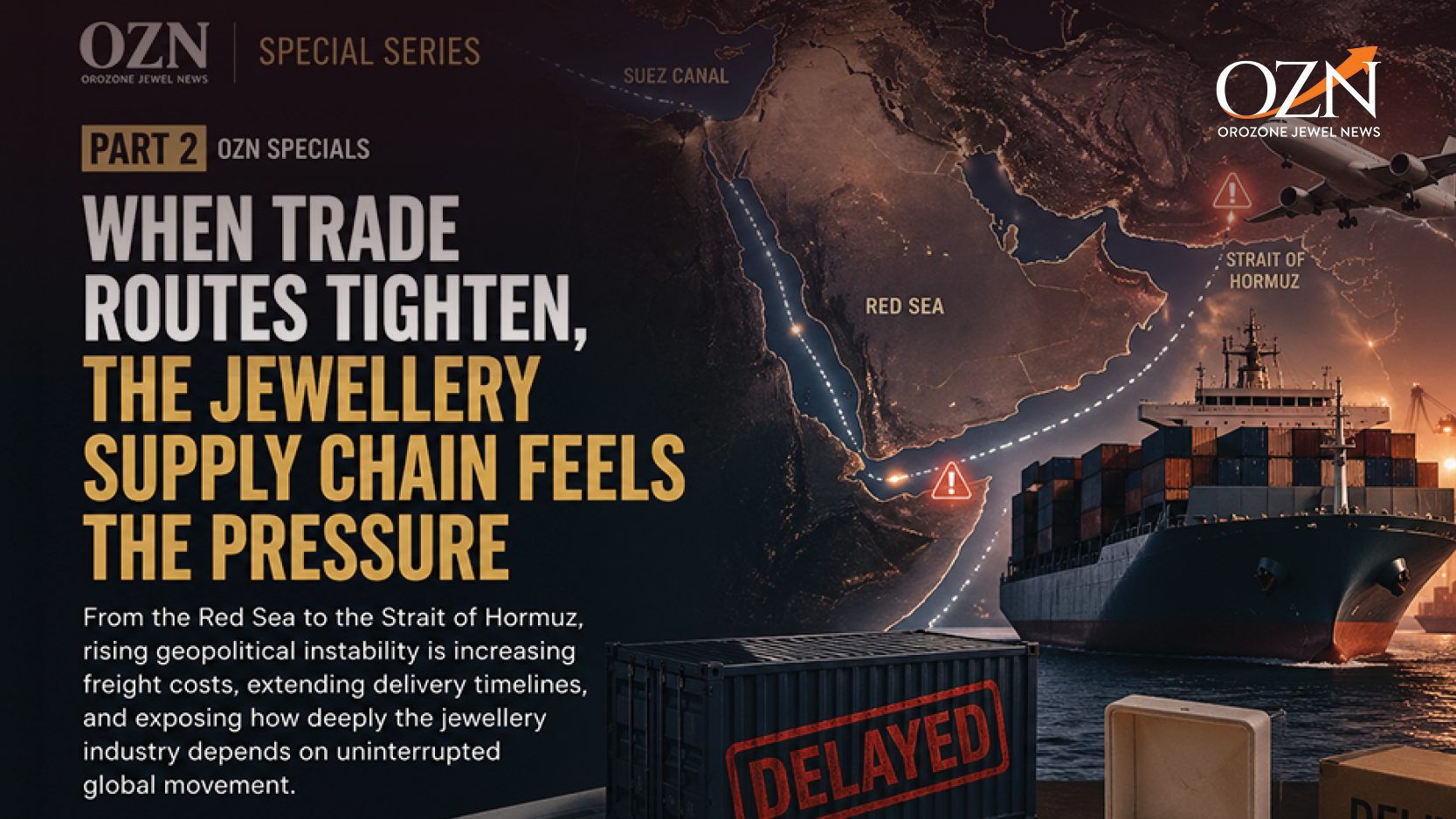
The current tensions across the Middle East
have once again highlighted the strategic importance of maritime corridors such
as the Red Sea, the Suez Canal, and the Strait of Hormuz. Together, these
routes facilitate a major share of global commercial shipping. The Strait of
Hormuz alone handles roughly one fifth of the world’s petroleum trade, making
it one of the most strategically sensitive waterways in the global economy.
While jewellery is not directly tied to energy, the sector is indirectly
exposed through shipping dependency, insurance costs, and fuel linked logistics
expenses.
The Red Sea corridor is particularly
critical because it connects Asian manufacturing economies to European and
Mediterranean markets through the Suez Canal. Any instability affecting this
route forces vessels to reroute around the Cape of Good Hope in southern
Africa, adding significant travel time and operational cost. In practical
terms, what would normally be a shorter and more commercially efficient route
can extend by several days or even weeks depending on congestion, vessel
scheduling, and port rotation.
For the jewellery trade, this matters
because the industry does not operate on bulk movement alone. It operates on
timing precision. Precious cargo is highly insured, tightly scheduled, and
often aligned with retail calendars, export commitments, bridal seasons, or
launch timelines. A delay of even a few days can affect order sequencing,
especially in export-oriented businesses working with seasonal merchandise or
scheduled retail drops.
India is among the most exposed jewellery
economies in this environment due to its central role in both manufacturing and
exports. The country remains one of the world’s largest importers of gold and
one of the most significant centres for diamond processing and jewellery
manufacturing. According to industry estimates, India imports between 800 and
900 tonnes of gold annually depending on pricing cycles and demand conditions.
It also processes the majority of the world’s small diamonds by volume, with
cities such as Surat functioning as major cutting and polishing hubs.
India’s gems and jewellery exports remain a
major contributor to trade, with exports spanning markets such as the United
States, the United Arab Emirates, Hong Kong, and several European destinations.
This export model is heavily dependent on predictable shipping schedules and
secure cargo movement. Any disruption in maritime reliability introduces
immediate business friction.
Inbound movement is equally sensitive. Gold
imports, rough diamonds, coloured gemstones, and specialised manufacturing
inputs all move through a network of ports, logistics providers, and customs
systems. Delays at any stage impact production planning. Manufacturers working
on export deadlines or custom orders are forced to recalibrate operations based
on material availability rather than forecasted demand.
This is especially relevant in the diamond
pipeline. Rough diamonds sourced from African producers including Botswana,
South Africa, Namibia, and Angola often pass through international trading hubs
before reaching India for processing. Trading ecosystems such as Dubai have
become increasingly important due to their logistical and commercial
positioning between producing and consuming markets.
When shipping routes become unstable, this
multi geography pipeline slows down. Delays in rough supply affect cutting
schedules. Delays in exports affect billing cycles and client commitments.
Businesses dependent on continuous throughput begin to experience friction
across every operational layer.
Insurance is another major pressure point.
High value cargo such as gold and diamonds already operates within strict risk
management systems. During periods of geopolitical instability, insurance
premiums for shipments moving through or near conflict sensitive zones
typically rise. This increases landed cost, which eventually flows through the
supply chain.
At the same time, rising crude oil prices
linked to Middle East instability add further cost pressure. Shipping costs
rise not only because of route changes but also because fuel linked expenses
increase. Domestic logistics, packaging movement, and last mile operational
costs are also indirectly affected.
For manufacturers, this creates a multi
layered margin challenge. Raw material volatility, freight inflation, insurance
increases, and delayed inventory cycles all begin compressing efficiency.
Working capital remains tied up for longer durations as goods stay in transit
or await processing. This is particularly challenging for mid sized businesses
operating on export cycles or tight liquidity structures.
Retailers face the impact differently.
Product launches may be delayed, inventory refresh cycles slow down, and
assortment depth becomes harder to maintain. Businesses become less aggressive
with stock building and more cautious in forward commitments.
In trading centres such as Dubai, which
functions as both a consumption and trade gateway for jewellery, the effects
are reflected through softer transactional speed and greater buyer caution.
Wholesale decision making slows as businesses assess market risk and shipping
reliability before committing.
What this period reveals most clearly is
the structural dependence of the jewellery industry on global continuity.
Jewellery is often perceived as a product of design and craftsmanship, but
commercially it is equally a logistics driven industry. Precious materials cross
borders multiple times before reaching the consumer. Gold is refined, diamonds
are traded and processed, components are sourced, products are manufactured,
and finished pieces are exported into highly time sensitive retail ecosystems.
When even one link becomes unstable, the
broader chain absorbs the pressure. Unlike sudden shutdowns, supply chain
disruption is gradual and cumulative. It begins with higher freight costs,
longer delivery schedules, and increased caution. Over time, these conditions
influence sourcing decisions, production models, export strategies, and
inventory structures.
The jewellery industry has repeatedly demonstrated resilience through volatility, but geopolitical instability reinforces an important lesson. Efficiency is no longer enough. Resilience, flexibility, and supply chain visibility are becoming equally important business assets. Because when trade routes tighten, the pressure is not limited to movement alone. It reshapes how the entire industry plans, prices, produces, and delivers.
Orozone Jewel News