Global: The
jewellery industry rarely reacts to events in isolation. Its response is
usually shaped by a combination of pricing, trade movement, and consumer
sentiment. When geopolitical tensions rise, particularly involving regions such
as the Middle East and countries like the United States and Iran, the first
visible signal is almost always in gold prices. Markets respond quickly to
uncertainty, and gold, as a long-established store of value, attracts capital
at a pace that is difficult for the physical jewellery trade to absorb.
This movement creates an immediate
imbalance. Gold becomes stronger as a financial asset, but more difficult to
use as a jewellery material. For the trade, stability in pricing is more
important than absolute price levels. Sudden increases, especially those driven
by external events rather than demand, disrupt planning across the value chain.
Manufacturers face uncertainty in procurement, retailers struggle with pricing
decisions, and consumers begin to reconsider timing.
India remains one of the most exposed
markets in this situation. As one of the largest consumers of gold globally,
with annual imports often ranging between 800 and 900 tonnes, the country is
directly affected by international price movements. Any increase in gold prices
is quickly reflected in domestic markets, leaving little room for adjustment.
Retailers are required to update pricing frequently, which can affect buyer
confidence, while holding prices steady impacts margins. This creates a
situation where every pricing decision carries risk.
At the same time, consumer behaviour begins
to shift in a noticeable way. Jewellery demand does not disappear, but it
becomes more selective. Buyers delay purchases, reduce budgets, or opt for
lighter designs. In a market where jewellery is closely linked to weddings and
cultural events, purchases are rarely cancelled outright, but they are often
postponed until there is greater clarity in pricing. The result is a slower
pace of transactions, particularly in higher value segments.
While pricing and demand form the visible
layer of impact, the more complex changes occur within trade and logistics. The
Middle East plays a central role in global shipping, with key routes such as
the Strait of Hormuz and the Red Sea handling a significant share of
international cargo movement. These routes are critical for the transport of
gold, diamonds, and finished jewellery between major markets.
When geopolitical tension rises in these
regions, the effect on shipping is immediate. Even without direct disruption,
the perceived risk leads to higher insurance costs, adjustments in shipping
routes, and longer transit times. Freight costs increase, and delivery
schedules become less predictable. For an industry that depends on timely
movement of high value goods, this creates operational pressure across multiple
levels.
India’s jewellery manufacturing sector is
particularly sensitive to these changes. The country depends on steady imports
of raw materials such as gold and rough diamonds, and exports a large volume of
finished jewellery to markets including the United States, the Middle East, and
Europe. When shipping becomes uncertain, import costs increase and export
timelines become harder to manage. Manufacturers begin to adjust production
based on available inventory rather than expected demand, leading to a more
cautious approach across the board.
The diamond supply chain adds another layer
to this complexity. Rough diamonds are sourced from regions such as Africa,
traded through hubs like Dubai, and processed in India before being exported
globally. This multi stage movement depends on consistency and timing. Any
delay at one stage affects the entire chain, creating a ripple effect that
slows down manufacturing and delivery cycles.
At the same time, rising geopolitical
tension often leads to higher oil prices, which increases transportation and
operational costs. For the jewellery industry, this means higher expenses not
only for international shipping but also for domestic logistics and
manufacturing processes. These cost increases may appear manageable
individually, but together they reduce overall efficiency and place additional
pressure on margins.
In major trading centres such as Dubai, the
impact is visible in more subtle ways. Trade activity continues, but with
greater caution. Buyers take longer to make decisions, transaction volumes
fluctuate, and retail demand becomes more sensitive to global developments.
Tourism, which plays an important role in jewellery sales in the region, is
also affected by geopolitical sentiment, further influencing market behaviour.
What defines this phase of impact is not
disruption in the traditional sense, but adjustment. The industry continues to
operate, but at a more measured pace. Retailers reduce aggressive inventory
expansion, manufacturers manage production more carefully, and exporters
approach new orders with caution. The focus shifts from growth to stability.
Over time, the jewellery industry has shown
an ability to adapt to changing conditions. However, each period of
geopolitical tension reinforces the same underlying reality. The industry is
closely linked to global systems, and even indirect changes in markets,
logistics, or sentiment can have a significant effect.
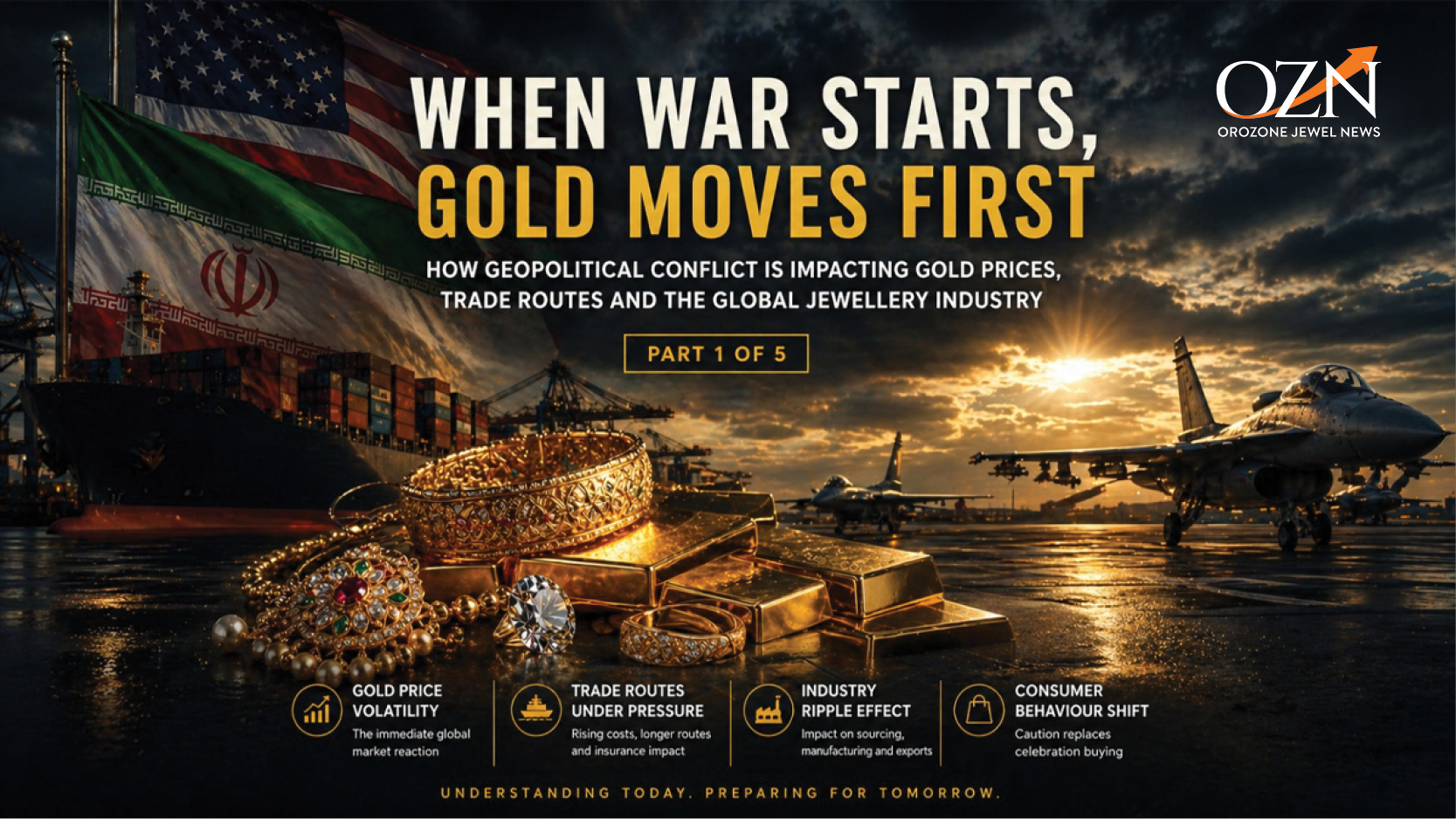
The first stage of war does not bring
immediate damage to the jewellery trade. Instead, it introduces a series of
changes that require careful management. Gold prices move first, driven by
global markets. Trade routes respond next, influenced by risk and cost.
Consumer behaviour follows, shaped by uncertainty and financial caution.
These changes do not stop the industry, but
they do reshape how it operates.
In times of conflict, jewellery continues to hold its importance, but the way it is bought, sold, and moved becomes more controlled, more deliberate, and more dependent on external conditions.
Orozone Jewel News